
Chicago has long been one of America’s greatest cities for pianists, producing influential performers across jazz, blues, boogie-woogie, gospel, rock, soul, and classical music. The city’s rich musical heritage, shaped by African American migration and a thriving club scene, helped establish Chicago as a major center for piano innovation throughout the twentieth century.
Among the most celebrated Chicago pianists was Jelly Roll Morton, whose years performing in the city helped spread early jazz throughout the Midwest. Earl Hines became one of jazz’s most revolutionary pianists while leading his orchestra from Chicago’s Grand Terrace Ballroom, developing a trumpet-like right-hand style that influenced generations of jazz musicians. Ahmad Jamal, although born in Pittsburgh, built much of his career in Chicago, where his elegant, minimalist approach to jazz piano became highly influential, inspiring artists such as Miles Davis.
Chicago was also home to some of the greatest blues and boogie-woogie pianists in history. Otis Spann became the definitive pianist of the Chicago blues scene through his work with Muddy Waters and his acclaimed solo recordings. Sunnyland Slim was another cornerstone of Chicago blues, helping define the city’s postwar electric blues sound while mentoring younger musicians. Memphis Slim relocated to Chicago during the 1930s and became one of the leading blues pianists before achieving international recognition. Boogie-woogie pioneers Meade “Lux” Lewis and Albert Ammons also developed their powerful piano styles in Chicago, making the city synonymous with the energetic genre during the swing era.
Chicago’s gospel tradition produced legendary pianists as well. Roberta Martin helped shape modern gospel music through her piano playing, songwriting, and leadership of the Roberta Martin Singers. Her innovative arrangements influenced countless gospel performers and church musicians throughout the United States.
The city’s influence extends into rock and popular music through artists such as Ramsey Lewis, whose blend of jazz, soul, and pop made him one of Chicago’s most successful musicians. Herbie Hancock, born and raised on Chicago’s South Side, became one of the most innovative pianists and keyboardists in jazz history, pioneering new directions in acoustic jazz, fusion, and electronic music. Classical pianist Garrick Ohlsson, another Chicago native, earned international acclaim after winning the prestigious International Chopin Piano Competition in 1970.
Today, Chicago remains a vibrant home for outstanding pianists performing in jazz clubs, blues venues, concert halls, and recording studios. From Earl Hines and Otis Spann to Herbie Hancock and Ramsey Lewis, the city’s pianists have helped shape American music, leaving a lasting legacy that continues to influence performers around the world.
Piano Players Tour Map -> Google Maps
Piano Players Tour Information -> PDF files
56 entries so far…
Seymour Lee Abernathy
James Alston
Joshua Altheimer
Albert Ammons
Lillian Hardin Armstrong
Cora “Lovie” Austin
Charles Anderson Avery
Richard Evans “Two Ton” Baker
James L. “Jimmy” Blythe
Judson Brown
Reginald Waymond “Sonny” Burke
Daniel Burley
Harold E. Burrage
Robert “Bob” Call
Glover Compton
Robert L. “Prince” Cooper
John Henry “Blind John” Davis, Jr.
William “Will” Ezell
Edgar Cecil “Piano C. Red” Fain
Leroy Roscoe “Blind Leroy” Garrett
Charles Harvey “Barrelhouse Chuck” Goering
James Hairston
Lillian E. “Lil Diamonds” Hardaway
Arthur W. “Art” Hodes
Tony Jackson
Johnnie “Little Johnny” Jones
Lafayette C. Leake
Clarence Lofton
Albert Luandrew “Sunnyland Slim”
“Professor” Eddie Lusk
Marian McPartland
Eurreal Wilford “Little Brother” Montgomery
Aaron Moore
Orlando Chester Murden
Joseph E. Nathaniel
Iromeio “Romeo” Nelson
Charles Clifford “Charlie Bozo” Nickerson
George Noble
James Burke “St. Louis Jimmy” Oden
Horace Milton Palm
Hartzell Strathdene “Tiny” Parkham
Everett “Happy” Robbins
Charles “Charlie” Segar
Ezra Norma (Rowlett) Shelton
Clarence “Pinetop” Smith
Lloyd William Smith
Otis Spann
Douglas “Doug” Suggs
George Washington Thomas, Jr.
Earma Jean (Grant) Thompson
Johnny Mayon “Big Moose” Walker
Eddie Lee Watson “Lovie Lee”
Emery Williams, Jr. “Detroit Junior”
Frank “Sweet” Williams
Alonzo Yancy
“Jimmy” James Edward Yancy
JAMES A. “JIMMY” BERTRAND (1900-1960)
Holy Sepulchre Catholic Cemetery
6001 W. 111th Street
Alsip, IL 60803
Sec. 9, Blk. 8, Lot 38, Grave 1 (unmarked per cemetery staff)
Jazz & Blues Drummer
Jimmy Bertrand was an influential jazz and blues percussionist whose career was closely tied to the development of the Chicago jazz scene during the 1920s and 1930s. Born in Biloxi, Mississippi, he moved to Chicago in 1913, where he studied percussion and began performing in theater orchestras before joining Erskine Tate’s Vendome Orchestra in 1918. Over the following decade, he established himself as one of the city’s leading drummers and washboard players, performing and recording with many of the era’s most important musicians, including Louis Armstrong, Johnny Dodds, Blind Blake, Ma Rainey, Tiny Parham, and Eddie South.
In addition to his work as a sideman, Bertrand led his own ensemble, Jimmy Bertrand’s Washboard Wizards, which featured notable collaborators such as Louis Armstrong and Jimmy Dodds. His recordings showcased not only his drumming but also his skill on the washboard, xylophone, and other percussion instruments, reflecting the versatility that made him a sought-after performer in both jazz and blues sessions.
Bertrand was equally significant as a teacher. He trained several future jazz greats, including Lionel Hampton, Big Sid Catlett, and Wallace Bishop. Hampton later referred to Bertrand as his “original idol,” highlighting the lasting influence Bertrand had on the next generation of percussionists. Although he continued leading bands into the early 1940s, he left professional music around 1944 to work in a Chicago meat-packing plant, making only occasional musical appearances thereafter. While he never achieved the fame of many of his contemporaries, Bertrand’s recordings, performances, and teaching established him as a foundational figure in early Chicago jazz and blues.
James A. “Jimmy” Bertrand -> Wikipedia
ALBERT AMMONS (1907-1949) – GRAVE
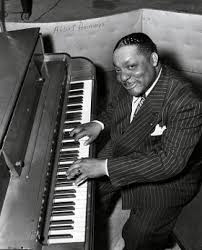
Boogie Woogie Piano
Albert Ammons was a boogie-woogie pianist who influenced many later piano players, such as Jerry Lee Lewis and Dr. John.
[ Lincoln Cemetery, Blue Island – Lot TLA, Lot 122, Row SW 1/2 – 41°40’13.9″N 87°42’07.1″W]
LILLIAN HARDIN ARMSTRONG (1898-1971) – CRYPT
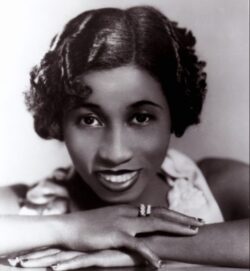
Lil Hardin Armstrong -> Wikipedia
Jazz Piano
Lil Hardin Armstrong was a piano player, composer, arranger, singer and bandleader. She was Louis Armstrong’s second wife, and they worked together in the 1920s. She also taught Louis how to dress better and to present himself better.
[ Lincoln Cemetery, Blue Island – Garden of Peace, Wall G, Tier 5, Crypt 63 – 41°40’07.9″N 87°42’05.0″W]